HPLC Method for Analysis of Benzalkonium chloride on Primesep SB by SIELC Technologies
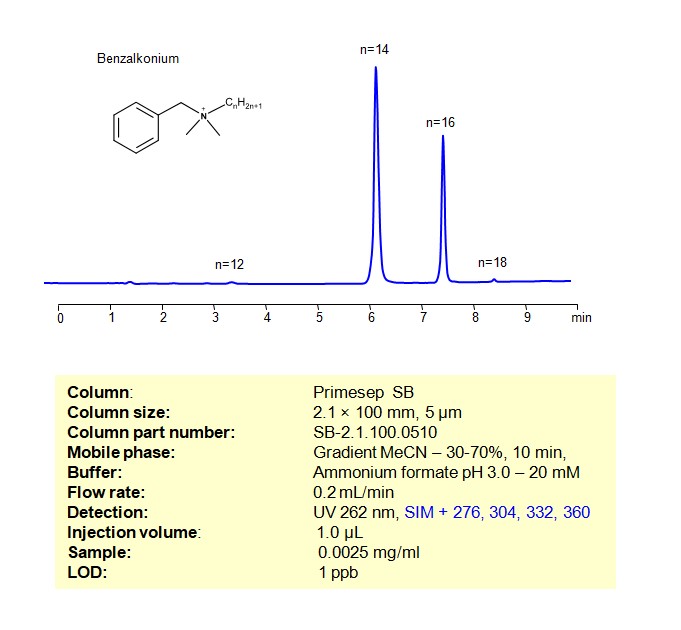
Benzalkonium chloride, also known as Zephiran or Alkyldimethylbenzylammonium chloride, is a positively charged surfactant with the chemical formula C6H5CH2N(CH3)2RCl. It is a quaternary ammonium compound that belongs to the class of chemicals known as cationic surfactants. It is often used as a pharmaceutical preservative and as an antiseptic. There are different variants of Benzalkonium chloride with varying alkyl chain lengths, and the specific composition may affect its properties and applications. You can find detailed UV spectra of Benzalkonium chloride and information about its various lambda maxima by visiting the following link.
Benzalkonium chloride can be retained, and analyzed using a Primesep SB mixed-mode stationary phase column. The analysis utilizes a gradient method with a simple mobile phase consisting of water, acetonitrile (MeCN), and ammonium formate as a buffer. Detection is achieved using UV and LC MS positive mode
| Column | Primesep SB, 2.1 x 100 mm, 5 µm, 100 A, dual ended |
| Mobile Phase | Gradient MeCN – 30 – 70%, 10 min |
| Buffer | Ammonium formate pH 3.0 – 40 mM |
| Flow Rate | 0.2ml/min |
| Detection | UV 262 nm, SIM + 276, 304, 332, 360 |
| Samples | 0.0025 mg/mL in MeCN/H2O – 50/50% |
| Injection volume | 1 µl |
| LOD* | 1 ppb |
| Class of Compounds | Alkaloid, Quaternary ammonium |
| Analyzing Compounds | Benzalkonium chloride |
Application Column
Primesep SB
Column Diameter: 2.1 mm
Column Length: 100 mm
Particle Size: 5 µm
Pore Size: 100 A
Column options: dual ended
LC MS Detection