HPLC Method for Potassium sorbate, Sorbic acid on Newcrom BH by SIELC Technologies
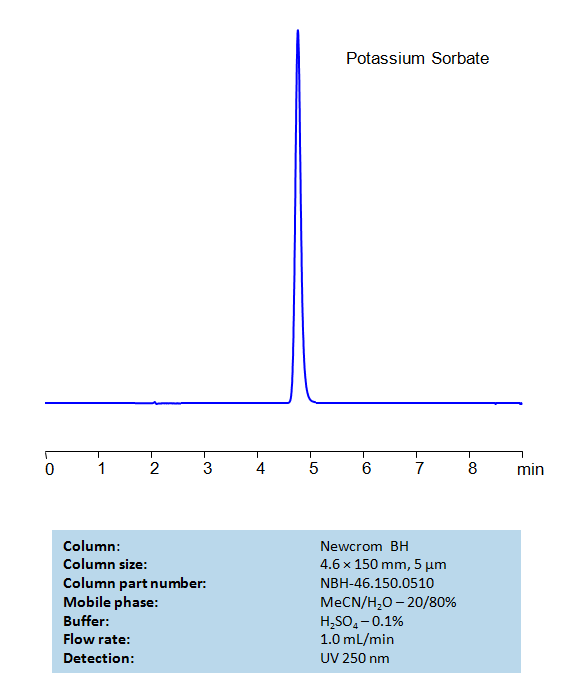
High Performance Liquid Chromatography (HPLC) Method for Analysis of Potassium sorbate, Sorbic acid.
Potassium Sorbate is a popular preservative with the chemical formula C6H7KO2. It is used in a wide variety of foods, wines, and personal-care products. It works through inhibiting molds, yeasts, and various other microbes. You can find detailed UV spectra of Potassium Sorbate and information about its various lambda maxima by visiting the following link.
Potassium sorbate, Sorbic acid can be retained and analyzed using the Newcrom BH stationary phase column. The analysis utilizes an isocratic method with a simple mobile phase consisting of water and acetonitrile (MeCN) with a sulfuric acid buffer. Detection is performed using UV.
| Column | Newcrom BH, 4.6 x 150 mm, 5 µm, 100 A, dual ended |
| Mobile Phase | MeCN – 20% |
| Buffer | H2SO4 – 0.1% |
| Flow Rate | 1.0 ml/min |
| Detection | UV 250 nm |
| Class of Compounds | Salt |
| Analyzing Compounds | Potassium sorbate, Sorbic acid |
Application Column
Newcrom BH
Column Diameter: 4.6 mm
Column Length: 150 mm
Particle Size: 5 µm
Pore Size: 100 A
Column options: dual ended
Sorbic acid