HPLC Method for Allura Red (Red #40) on BIST A by SIELC Technologies
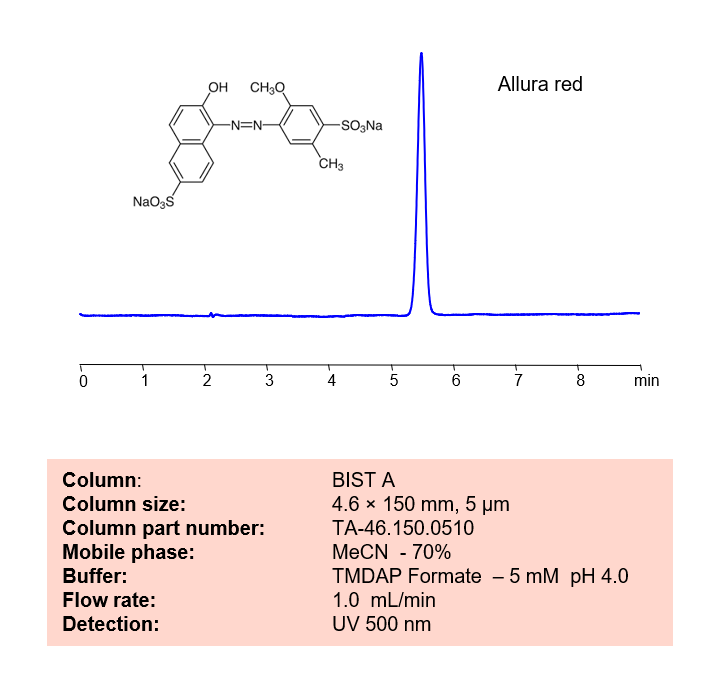
Allura Red AC, also known as FD&C Red No. 40, is a red azo dye that is the most commonly used red dye in the United States. It is used anywhere from tattoos to children’s’ medications to drinks and food. If used in food it also has the E number E129. Allura red is sold as a dark red sodium salt, but when dissolved in water, the solution appears orange-red. You can find detailed UV spectra of Allura Red (Red #40) and information about its various lambda maxima by visiting the following link.
Using SIELC’s newly introduced BIST™ method, Allura Red (Red #40) which ionizes in water, can be retained on a negatively-charged, cation-exchange BIST A column. There are two keys to this retention method: 1) a multi-charged, positive buffer, such as N,N,N’,N’-Tetramethyl-1,3-propanediamine (TMDAP), which acts as a bridge, linking the negatively-charged Acid Red 1 analytes to the negatively-charged column surface and 2) a mobile phase consisting mostly of organic solvent (such as MeCN) to minimize the formation of a solvation layer around the charged analytes. Using this new and unique analysis method, Allura Red can be retained and UV detected at 500 nm.
Condition
| Column | BIST A, 4.6 x 150 mm, 5 µm, 100 A, dual ended |
| Mobile Phase | MeCN |
| Buffer | TMDAP phosphate – 5 mM pH 4.0 |
| Flow Rate | 2.0 mL/min |
| Detection | Vis 600 nm |
Description
| Class of Compounds | Dyes |
| Analyzing Compounds | Allura Red (Red #40) |
Application Column
BIST A
Column Diameter: 4.6 mm
Column Length: 150 mm
Particle Size: 5 µm
Pore Size: 100 A
Column options: dual ended