HPLC Method for Aconitic acid, trans-Aconitic acid on BIST A+ by SIELC Technologies
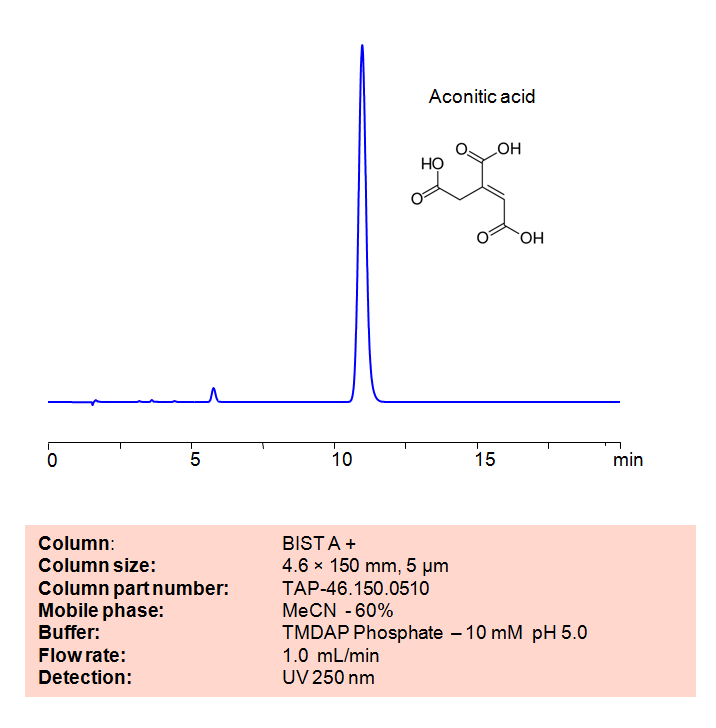
Aconitic acid is a popular compound used to artificial with the chemical formula C6H6O6. It is used to create nutty flavors in foods. It is also a common intermediate in the Kreb’s cycle when Citrate is changed into D-isocitrate.
Using SIELC’s newly introduced BIST™ method, [compound] can be retained easily on a negatively-charged, cation-exchange BIST A+ column. There are two keys to this retention method: 1) a multi-charged, positive buffer, such as N,N,N’,N’-Tetramethyl-1,3-propanediamine (TMDAP), which acts as a bridge, linking the negatively-charged anion analytes to the negatively-charged column surface and 2) a mobile phase consisting mostly of organic solvent (such as MeCN) to minimize the formation of a solvation layer around the charged analytes. Other positively-charged buffers that can generate BIST™ include DMP, Calcium acetate, and Magnesium acetate. Using this new and unique analysis method, Aconitic acid can be retained with high selectivity and great peak shape. This method can be detected and is compatible with ELSD, CAD, and Mass Spectrometry (LC-MS).
Condition
| Column | BIST A+, 4.6 x 150 mm, 5 µm, 100 A, dual ended |
| Mobile Phase | MeCN – 60% |
| Buffer | TMDAP Phosphate pH 5.0 – 10 mM |
| Flow Rate | 1.0 ml/min |
| Detection | UV 250 nm |
Description
| Class of Compounds | Acid |
| Analyzing Compounds | Aconitic acid, trans-Aconitic acid |
Application Column
BIST A+
Column Diameter: 4.6 mm
Column Length: 150 mm
Particle Size: 5 µm
Pore Size: 100 A
Column options: dual ended
trans-Aconitic acid