Step 6
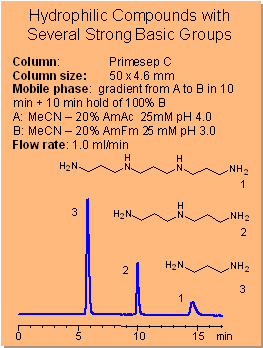
We have established that your compound is a hydrophilic strong base which contains more than one basic group. Below is an example of a separation of a similar compound. This example can be used as a starting condition in your method development.
Hydrophilic basic compounds have no or very low interaction with the stationary phase by reverse phase mechanism. Instead, the positive charge of the molecule can be used as a means of retention in ion-exchange mode. The problem is, that when the molecule has more than one strong basic group, the retention is too strong. For this situation, the weakest Primesep cation-exchange column, such as Primesep C, should be used. This column has an embedded carboxilic acid with pKa around 3.5. At a pH above 4, the column has a strong cation-exchange properties. At a pH below 3, the cation-exchange properties of the Primesep C column are significantly suppressed. The typical approach would include a pH gradient from 4.5 to 3.0 by using ammonium acetate – ammonium phosphate buffer systems.